Multisig Wallets for Inheritance: Why Single Keys Are Not Enough
The single private key is both the greatest strength and the greatest weakness of cryptocurrency. It gives you absolute control over your assets — no bank, no government, no intermediary can freeze or seize your funds. But that same absolute control means that if the key is compromised, lost, or buried with its holder, the assets are gone. For crypto inheritance, this single-key model creates a fundamental problem: how do you transfer control to heirs without exposing the key during your lifetime?
Multisig wallets solve this problem by distributing control across multiple parties. This article explores why single keys fall short for inheritance, how multisig works, and how combining multisig with a dead man's switch creates the most robust inheritance solution available today.
The Risks of Single-Key Wallets
A standard cryptocurrency wallet is protected by a single private key. Whoever holds that key has full, unrestricted access to the funds. In the context of inheritance, this creates several dangerous scenarios:
Key Loss
If the owner dies without sharing the private key or seed phrase, the assets are permanently locked. No recovery mechanism exists on the blockchain itself. Studies estimate that millions of Bitcoin are irretrievably lost because the key holders are deceased or have forgotten their credentials.
Premature Exposure
To prepare for inheritance, some owners share their seed phrase with a spouse, child, or attorney. But the moment you share a private key, you lose exclusive control. The recipient can access the funds at any time — not just after your death. You are trusting them completely, with no technical safeguard.
Theft and Coercion
A single key stored in a safe, a drawer, or a password manager is a single target. If a bad actor gains access to that one piece of information, they gain access to everything. Physical theft, social engineering, and coercion are all realistic threats, especially for high-value wallets.
No Accountability
Single-key transactions leave no trail of authorization. There is no way to verify that a transfer was legitimate, approved by the right people, or executed under the right circumstances. For inheritance, where the rightful owner is no longer present to authorize transfers, this lack of accountability is a serious gap.
What Is a Multisig Wallet?
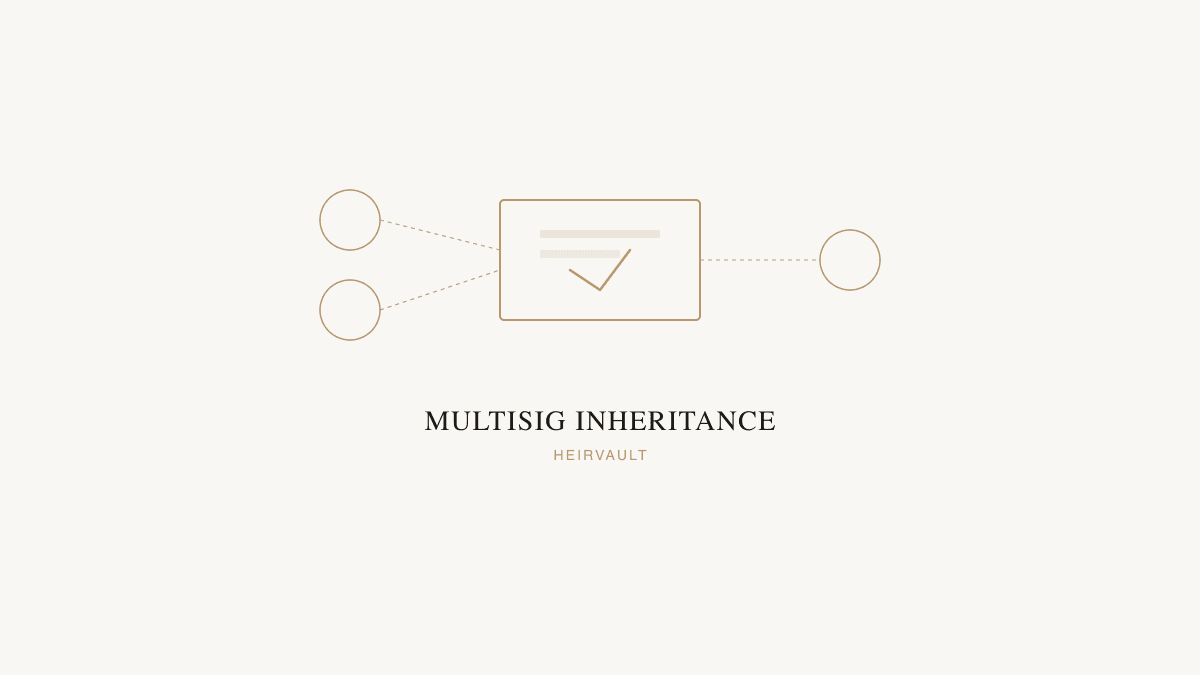
A multisig (multi-signature) wallet is a smart contract or protocol that requires multiple private keys to authorize a transaction. Instead of one key controlling everything, a multisig wallet uses an M-of-N scheme: M signatures out of N total signers must approve before any funds can move.
For example, a 2-of-3 multisig wallet has three authorized signers, and any two of them must sign a transaction for it to execute. This simple structure has profound implications for security and inheritance.
Multisig is not a new concept. It has been used in Bitcoin since 2012 and is a standard feature of Ethereum smart contracts. Major DAOs, exchanges, and protocol treasuries rely on multisig to protect billions of dollars in assets.
How Multisig Works
The mechanics of a multisig wallet depend on the blockchain, but the general process is consistent:
- Wallet creation. The multisig contract is deployed with a defined set of signers and a threshold (M-of-N).
- Transaction proposal. One signer initiates a transaction by submitting it to the contract.
- Signature collection. Other signers review the proposed transaction and add their signatures.
- Execution. Once the threshold number of signatures is reached, the contract executes the transaction.
Each step is recorded on-chain, providing a transparent and auditable record of every action taken.
Guardian Roles in Crypto Inheritance
In a multisig inheritance setup, the signers are not random parties — they play specific roles designed to balance security with accessibility. HeirVault uses the concept of guardians to formalize these roles.
The Owner
The vault creator who deposits assets and configures the inheritance rules. During normal operation, the owner has full control and can update settings, add or remove heirs, and withdraw funds without additional signatures.
The Heir
The designated beneficiary who will receive assets after the owner becomes inactive. The heir can initiate a claim when the vault's dead man's switch triggers, but they cannot act alone — guardian co-signatures are required.
The Guardian
A trusted individual appointed by the owner to co-sign heir claims. Guardians cannot access the vault's funds independently. Their sole function is to verify that a claim is legitimate and add their signature. Guardians serve as a human verification layer on top of contract-enforced claim logic.
A typical configuration might include two or three guardians, with a threshold requiring at least two signatures (including the heir's) to approve a claim. This means no single guardian can collude with an heir to drain the vault, and no heir can claim assets without independent verification.
Threshold Signatures and Security
The M-of-N threshold is the core security parameter of any multisig setup. Choosing the right threshold depends on your specific situation:
2-of-3
The most common configuration for personal inheritance. Three signers (typically the heir and two guardians), with two required to approve. This provides redundancy — if one guardian is unavailable, the remaining guardian and the heir can still complete the claim.
3-of-5
Suitable for high-value vaults or situations where additional oversight is desired. Five signers with three required. This configuration is more resilient to individual signer compromise but requires more coordination.
1-of-2
A lighter configuration where either the heir or a single guardian can approve. This is less secure but may be appropriate for smaller amounts or situations where simplicity is prioritized.
The threshold should reflect your trust assumptions and the value at stake. Higher thresholds provide more security but increase the coordination burden on your heirs during what is likely already a difficult time.
Use Cases for Multisig Inheritance
Family Succession
A parent holds crypto assets and designates their two children as heirs, with a family attorney and a trusted friend as guardians. When the dead man's switch triggers, either child can initiate a claim, but the attorney and friend must co-sign before assets are released. This prevents any single family member from acting unilaterally.
Business Partner Continuity
Two business partners each hold vaults with the other as heir and a shared accountant as guardian. If one partner becomes incapacitated, the other can claim the business crypto assets with the accountant's verification, ensuring business continuity.
Cross-Generational Wealth Transfer
A grandparent sets up a vault for grandchildren who are currently minors. The parents serve as guardians, and the vault is configured with a long inactivity period. When the grandchildren come of age and the switch eventually triggers, the parents co-sign to release the inheritance.
Charitable Bequests
A crypto holder designates a charitable organization as heir, with two personal contacts as guardians. This ensures the donation only proceeds after the holder's inactivity is confirmed and verified by people who knew them personally.
Preventing Unauthorized Access
Multisig provides multiple layers of defense against unauthorized claims:
Collusion Resistance
For a bad actor to steal from a multisig vault, they would need to compromise multiple independent signers simultaneously. In a 2-of-3 setup, an attacker needs at least two private keys — a dramatically harder proposition than stealing one.
Time-Lock Integration
When multisig is combined with a dead man's switch, an additional time barrier protects the assets. Even if an attacker compromises enough signers, they cannot claim assets until the inactivity period expires. The owner can check in at any time to reset the timer and invalidate the attack.
On-Chain Transparency
Every multisig transaction is recorded on the blockchain. Guardians can monitor the vault for suspicious activity, and any unauthorized attempt to move funds is publicly visible. This transparency acts as both a deterrent and a forensic tool.
Revocation
The owner can revoke a guardian's signing authority at any time while the vault is active. If a guardian's key is compromised or trust is lost, the owner simply removes them and appoints a replacement. This dynamic control is impossible with static key-sharing approaches.
Combining Multisig With a Dead Man's Switch
The most powerful configuration for crypto inheritance uses both mechanisms together. Here is how the combined system works:
- Normal operation. The owner checks in periodically to reset the dead man's switch. The vault is locked and no one — not heirs, not guardians — can access the funds.
- Inactivity detected. The owner misses a check-in and the inactivity period expires. The vault enters an unlockable state.
- Claim initiation. An heir submits a claim transaction to the vault contract.
- Guardian approval. Designated guardians review the claim, verify its legitimacy, and co-sign.
- Asset release. Once the required threshold of signatures is collected, the smart contract releases assets to the heir's wallet.
This dual-layer approach means that neither the dead man's switch alone nor the multisig alone is sufficient to move funds. Both conditions must be satisfied — time must have elapsed, and multiple parties must approve. The result is a system that is extremely difficult to exploit and straightforward for legitimate heirs to navigate.
For a comprehensive overview of how these mechanisms fit into a broader succession strategy, see our complete guide to crypto inheritance planning.
How HeirVault Uses Multisig for Claims
HeirVault's inheritance vaults are built on a smart contract architecture that integrates multisig at every level of the claim process. When you create a vault, you define:
- Heir addresses and allocations. Who receives what, and in what proportion.
- Guardian addresses. Who must co-sign claims.
- Approval threshold. How many signatures are required.
- Inactivity period. How long the dead man's switch waits before triggering.
The claim process is designed to be accessible even for heirs with limited blockchain experience. HeirVault's interface guides claimants through wallet connection, claim submission, and guardian coordination. Guardians receive notifications when a claim is pending and can approve directly through the platform.
All of this happens on-chain. The smart contract enforces the rules, records every action, and executes the final transfer. No centralized server, no customer support ticket, no legal intermediary stands between the heir and their inheritance.
Bitcoin and Multi-Chain Considerations
Multisig support varies across blockchain networks. Bitcoin has native multisig capabilities through P2SH (Pay-to-Script-Hash) addresses, while Ethereum and EVM-compatible chains implement multisig through smart contracts. Each approach has trade-offs in terms of gas costs, flexibility, and tooling.
For holders with assets across multiple chains, a multi-chain inheritance strategy is essential. HeirVault supports vault creation across supported networks, allowing you to configure chain-specific inheritance rules while maintaining a unified management interface. For more on protecting Bitcoin specifically, see our article on Bitcoin inheritance solutions.
Choosing Your Guardians
The security of your multisig inheritance setup depends heavily on your choice of guardians. Here are the key criteria to consider:
- Trustworthiness. Guardians should be people you trust to act in your heirs' best interest, not their own.
- Technical competence. Guardians need to be able to connect a wallet and sign a transaction. They do not need to be blockchain experts, but they should be comfortable with basic operations.
- Availability. Choose guardians who are likely to be accessible when needed, potentially years from now. Younger, healthy, geographically distributed individuals are preferable.
- Independence. Guardians should be independent of each other and of the heirs. This reduces collusion risk and ensures genuine multi-party verification.
- Replaceability. Plan for the possibility that a guardian may need to be replaced. Keep your guardian list current and review it annually.
Common Misconceptions
Multisig Is Too Complicated for My Family
Modern multisig interfaces have come a long way. Platforms like HeirVault abstract the underlying complexity into guided workflows. Your heirs and guardians do not need to understand elliptic curve cryptography — they need to connect a wallet and click a button.
I Only Need Multisig or a Dead Man's Switch, Not Both
Each mechanism addresses a different threat. The dead man's switch handles the timing problem (when should assets be released?), while multisig handles the authorization problem (who should approve the release?). Using only one leaves a gap that the other fills.
Multisig Means I Lose Control
As the vault owner, you retain full control during normal operation. Guardians and heirs have no access to your funds while you are actively checking in. Multisig only activates during the claim process, after the dead man's switch has triggered.
Conclusion
Single-key wallets are a liability for crypto inheritance. They create single points of failure, force owners into uncomfortable security trade-offs, and leave heirs vulnerable to loss, theft, and confusion. Multisig wallets eliminate these problems by distributing trust across multiple parties and requiring collective approval for any asset transfer.
When combined with a dead man's switch, multisig creates an inheritance system that is secure during your lifetime, accessible to your heirs after your passing, and transparent at every stage. It is the closest thing to a trustless succession plan that exists today.
Do not leave your heirs to navigate a single-key inheritance. Create a multisig inheritance vault on HeirVault and build a succession plan that is as resilient as the blockchain itself.