Disclaimer: This article is for educational and informational purposes only. It does not constitute legal, tax, or financial advice. Inheritance and succession laws vary significantly by jurisdiction and change over time. Consult a qualified legal professional with expertise in cross-border estate planning before making any decisions based on the information presented here.
Most people assume they can leave their crypto to whoever they want. In many countries, that assumption is wrong. Forced heirship laws -- present across continental Europe, Russia, much of Latin America, and parts of the Middle East and Asia -- guarantee certain family members a minimum share of every estate. These rules apply regardless of what a will says, and they do not carve out exceptions for digital assets. If you hold cryptocurrency and live in (or have ties to) a forced heirship jurisdiction, ignoring these rules does not make them go away. It creates legal risk for your heirs and can result in costly court challenges that drain the very estate you were trying to protect.
This guide covers what forced heirship is, how it works in the major jurisdictions that enforce it, why crypto does not get a special exemption, and the planning strategies available to navigate these rules without running afoul of the law. For a broader overview of structuring your digital estate, see our crypto inheritance planning guide. For tax-specific considerations, our crypto inheritance tax guide for 2026 covers cost basis, reporting, and related topics.
What Is Forced Heirship?
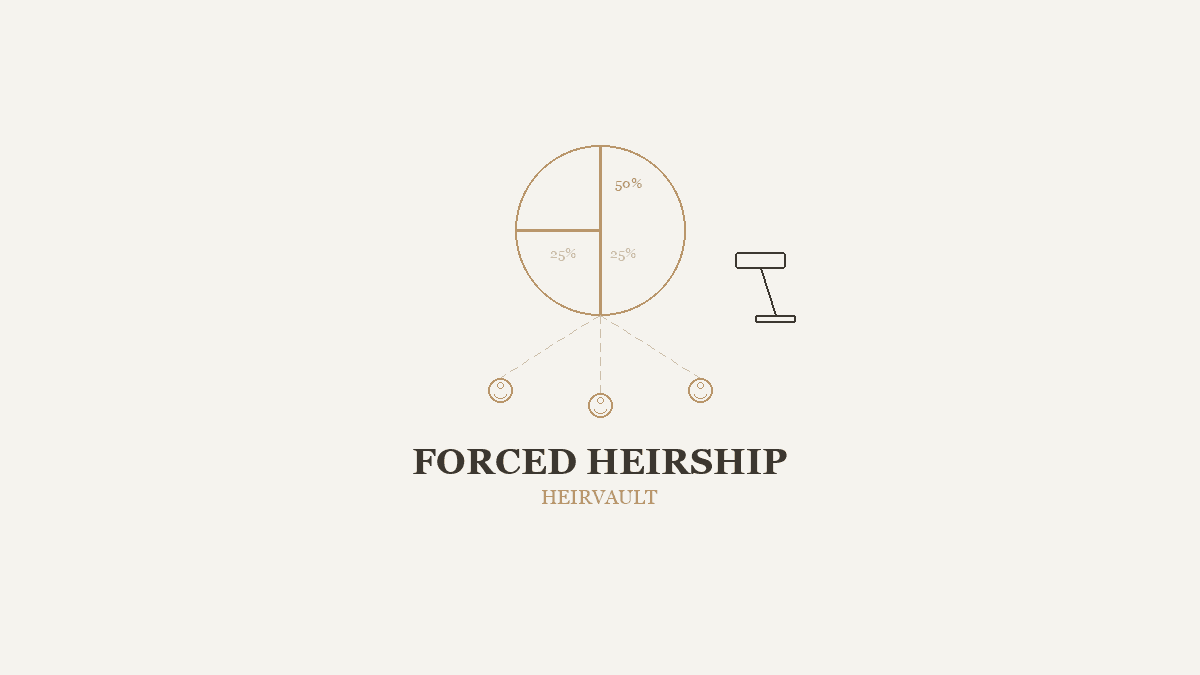
Forced heirship is a legal doctrine that requires a person to leave a minimum percentage of their estate to certain protected family members. Unlike common law systems -- where testamentary freedom allows you to leave your assets to anyone you choose -- civil law systems impose mandatory shares that cannot be overridden by a will, a trust, or any other private arrangement.
The core idea behind forced heirship is straightforward: certain family members have a right to inherit, and that right cannot be defeated by the deceased's preferences alone. The law treats inheritance not purely as a matter of individual choice, but as a family obligation rooted in centuries of legal tradition.
Who Is Protected?
The specific categories of protected heirs vary by country, but the most commonly protected groups include:
- Children (including adopted children, and in some jurisdictions, children born outside of marriage): Nearly every forced heirship system protects descendants. Children are the primary beneficiaries of mandatory shares in virtually all civil law jurisdictions.
- Surviving spouse: Most systems grant the spouse either a direct mandatory share or specific usage rights (such as the right to remain in the family home). The extent of spousal protection varies widely.
- Parents: In some jurisdictions, if the deceased has no children, parents become protected heirs. This is common in Russian and Swiss law.
- More distant relatives: A small number of systems extend protection to siblings or grandparents, though this is relatively rare.
Forced Heirship vs. Freedom of Testation
The philosophical divide between forced heirship and freedom of testation is one of the deepest in inheritance law. Common law jurisdictions -- the United States, England and Wales, Australia, and most of Canada -- generally allow testators to distribute their estate as they see fit, with limited exceptions for dependents. Civil law jurisdictions take the opposite approach: the law defines a floor below which protected heirs cannot be pushed, and the testator's discretion applies only to the remaining "free" portion of the estate.
This distinction matters enormously for crypto holders. If you are accustomed to the common law principle that your assets are yours to allocate freely, encountering forced heirship for the first time can be disorienting. The rules are mandatory, not advisory. A will that violates forced heirship can be challenged and partially invalidated by any protected heir who was shortchanged.
How Forced Heirship Interacts with Crypto
From a legal standpoint, cryptocurrency is an asset. It has value, it can be transferred, and it forms part of the deceased's estate for succession purposes. Every jurisdiction that classifies crypto as property -- which now includes essentially all major economies -- subjects it to the same inheritance rules that govern bank accounts, real estate, and securities. Forced heirship makes no distinction between a Paris apartment and a Bitcoin wallet. Both are estate assets, and both must be divided according to the applicable mandatory shares.
The challenge with crypto is not legal classification. It is enforcement. Blockchain assets can be transferred instantly, pseudonymously, and across borders, making it technically possible to circumvent forced heirship in ways that are difficult (though not impossible) to detect. But the legal obligation remains, and the consequences of violating it -- from civil claims to criminal penalties -- are real.
Country-by-Country Rules
The specifics of forced heirship vary significantly from one jurisdiction to the next. Below is a detailed overview of how the major civil law jurisdictions structure their mandatory inheritance shares. If you hold crypto and have any connection to these countries -- through citizenship, residence, or asset location -- these rules may apply to your estate.
France (Reserve Hereditaire)
France has one of the most robust forced heirship regimes in Europe. The rules are codified in the French Civil Code and apply to all assets forming part of a French-domiciled estate, including cryptocurrency.
Mandatory Shares for Children
The reserved portion (reserve hereditaire) depends on the number of children:
- One child: The child is entitled to 50% of the estate. The remaining 50% is the freely disposable portion (quotite disponible).
- Two children: The children collectively are entitled to 66.67% (two-thirds) of the estate. Each child receives an equal share of the reserved portion.
- Three or more children: The children collectively are entitled to 75% of the estate. The freely disposable portion shrinks to 25%.
Spouse's Position
The surviving spouse is not a forced heir in the strict sense under French law. However, the spouse has significant statutory rights, including the option to choose between a life interest (usufruit) in the entire estate or full ownership of a defined share. These rights interact with the children's reserved portions and must be carefully coordinated.
Lifetime Gifts and Rapport
French law employs a mechanism called rapport des donations, which requires that gifts made during the deceased's lifetime be "brought back" into the estate calculation for purposes of determining the reserved portions. If you transferred crypto to a friend during your lifetime, that transfer may be added back to the notional estate to calculate whether the children's reserved shares have been satisfied.
This clawback mechanism is particularly relevant for crypto holders who might consider transferring assets before death to avoid forced heirship. French law anticipates this strategy and counteracts it through the rapport system. The look-back period is essentially unlimited for gifts to heirs and extends to gifts made to third parties as well, subject to certain limitations.
Practical Impact for Crypto Holders
A French resident with three children and a significant crypto portfolio can freely dispose of only 25% of their total estate (including lifetime gifts). The remaining 75% must go to the children in equal shares. Any on-chain allocation that deviates from this requirement can be challenged in French courts, and the courts have the power to order compensation or restitution.
Germany (Pflichtteil)
Germany's forced heirship system operates through the Pflichtteil (compulsory portion), which gives protected heirs a monetary claim against the estate rather than a direct share of specific assets. This distinction is important: German forced heirship does not prevent you from leaving assets to whomever you wish, but it guarantees that shortchanged heirs can demand cash compensation.
How the Pflichtteil Works
The Pflichtteil entitles protected heirs to 50% of what they would have received under intestate succession (i.e., if there were no will at all). The statutory intestate shares depend on the family composition and the matrimonial property regime.
For example:
- If a deceased person is survived by a spouse and two children, the intestate share for each child would typically be 25% of the estate (assuming the standard matrimonial regime of Zugewinngemeinschaft). The Pflichtteil for each child would then be 12.5% of the estate.
- The surviving spouse's Pflichtteil is calculated similarly: 50% of the intestate share the spouse would have received.
Cannot Be Excluded by Will
A testator can write a will that leaves everything to a single beneficiary. The will is valid. But the disinherited children and spouse retain their Pflichtteil claims, which they can enforce as monetary claims against the estate. The beneficiary who received the assets may be required to liquidate a portion of the estate to satisfy these claims.
The 10-Year Clawback (Pflichtteilserganzungsanspruch)
German law includes a specific anti-avoidance rule for lifetime gifts. Under the Pflichtteilserganzungsanspruch, gifts made within 10 years before the testator's death are added back to the estate for Pflichtteil calculation purposes. The clawback amount decreases by 10% for each year that passes after the gift:
- A gift made one year before death is added back at 100%.
- A gift made five years before death is added back at 60%.
- A gift made nine years before death is added back at 20%.
- A gift made more than 10 years before death is fully excluded.
For crypto holders, this means that transferring assets to a preferred beneficiary during your lifetime does not automatically eliminate Pflichtteil claims. If you die within 10 years of the transfer, the value of the gifted crypto (at the time of the gift, adjusted for inflation in some cases) is factored back into the calculation.
Practical Impact for Crypto Holders
A German crypto holder who wants to leave everything to a charitable foundation must still contend with the Pflichtteil claims of children and spouse. The foundation will receive the assets, but it may owe substantial cash payments to the forced heirs. Planning around the 10-year clawback requires long-term thinking and precise timing.
Russia (Obyazatelnaya Dolya)
Russian forced heirship law protects a narrower class of heirs but applies with particular rigidity. The rules are found in Article 1149 of the Russian Civil Code.
Who Is Protected
Russian law protects the following categories of heirs:
- Minor children of the deceased (under 18)
- Disabled children of any age
- Disabled spouse of the deceased
- Disabled parents of the deceased
- Disabled dependents who were maintained by the deceased for at least one year prior to death
The key qualifier in Russian law is disability or minority. Adult, able-bodied children do not have forced heirship rights under Russian law. This is a significant difference from the French and German systems, which protect all children regardless of age or health status.
Size of the Mandatory Share
Protected heirs are entitled to at least 50% of what they would have received under intestate succession. Russian intestate rules divide the estate equally among first-priority heirs (children, spouse, and parents), so the mandatory share depends on the total number of heirs in that priority class.
For example, if a deceased person is survived by a disabled spouse and two minor children, and no will exists, each would receive one-third of the estate under intestacy. With a will that excludes them, each protected heir can claim at least one-sixth of the estate (50% of one-third).
Gifts and Clawback
Russian law also has provisions for challenging gifts made in contemplation of death or in fraud of heirs' rights. While the clawback mechanisms are less formalized than in Germany, Russian courts have the authority to set aside transfers that were designed to circumvent forced heirship obligations. The burden of proof falls on the challenging heir, but courts have been receptive to these claims, particularly where the timing of the transfer suggests intent to evade.
Practical Impact for Crypto Holders
Russian crypto holders with minor children or disabled family members must account for their mandatory shares. The increasing sophistication of Russian tax authorities in tracking crypto transactions (Russia introduced crypto tax reporting requirements in recent years) means that hiding digital assets is a diminishing option. Courts can order compensation from any available estate assets, including directing the liquidation of crypto holdings.
Spain (Legitima)
Spain's forced heirship system is notable for its complexity. The national rules establish a baseline, but several autonomous communities have their own distinct inheritance regimes, creating a patchwork that requires careful analysis.
National Rules (Codigo Civil)
Under the Spanish Civil Code, the estate is divided into three portions:
- Legitima estricta (strict legitimate portion): One-third of the estate, divided equally among all children.
- Mejora (improvement portion): One-third of the estate, which must go to children but can be divided unequally among them.
- Libre disposicion (free portion): One-third of the estate, which the testator can leave to anyone.
In total, children are collectively entitled to two-thirds of the estate. The testator can distribute the mejora portion among the children as they see fit, but it cannot go to non-descendants. Only the remaining one-third is freely disposable.
Surviving Spouse
The surviving spouse has a right to usufruct (usage rights) over a portion of the estate, the exact percentage depending on whether the deceased has children or surviving parents. The spouse does not receive outright ownership under the legitima system but has the right to use and benefit from a share of the assets during their lifetime.
Autonomous Community Variations
Spain's autonomous communities have significant legislative autonomy in inheritance matters. The most notable variations include:
- Catalonia: Has its own Civil Code with different forced heirship rules. The legitimate portion for children is 25% of the estate (significantly less than the national 66.67%). The testator has greater freedom of testation.
- Basque Country: Has historically allowed greater testamentary freedom, and recent reforms have further reduced forced heirship constraints.
- Aragon: Maintains its own system with a collective legitima that can be allocated entirely to a single descendant.
- Navarre: Essentially has no forced heirship for descendants beyond a symbolic requirement.
- Balearic Islands and Galicia: Each have their own variations on the national rules.
Practical Impact for Crypto Holders
A crypto holder domiciled in Madrid faces the national rules (two-thirds to children), while one in Barcelona falls under Catalan rules (25% to children). The difference is dramatic, and domicile determination can be contested. For cross-border crypto holders, the interaction between Spanish regional rules and EU succession regulations (discussed below) adds another layer of complexity.
Italy (Quota di Legittima)
Italy's forced heirship system is among the most protective in Europe. The mandatory shares are substantial, leaving relatively little room for testamentary discretion.
Mandatory Shares by Family Composition
The Italian Civil Code establishes the following reserved shares:
- One child, no spouse: The child is entitled to 50% of the estate.
- One child and a surviving spouse: The child receives 33.33%, the spouse receives 33.33%, and the remaining 33.33% is freely disposable.
- Two or more children and a surviving spouse: The children collectively receive 50%, the spouse receives 25%, and the remaining 25% is freely disposable.
- Spouse alone (no children or parents): The spouse is entitled to 50% of the estate.
- Spouse and parents (no children): The spouse receives 50%, the parents receive 25%, and the remaining 25% is freely disposable.
- Two or more children, no spouse: The children collectively receive 66.67%, and the remaining 33.33% is freely disposable.
Azione di Riduzione (Reduction Action)
Italian law provides protected heirs with the azione di riduzione, a legal action to reduce testamentary dispositions and lifetime gifts that infringe on the reserved shares. This action has a 10-year limitation period from the opening of the succession (death) and can reach back to claw back gifts made during the testator's lifetime.
The reduction action operates in a specific order: first, testamentary dispositions are reduced (starting with the most recent), and only if that is insufficient, lifetime gifts are targeted (again, most recent first). This ordered approach can create complex litigation when multiple gifts and bequests are involved.
Practical Impact for Crypto Holders
An Italian crypto holder with two children and a spouse can freely dispose of only 25% of their total estate. The remaining 75% is locked in by law. For a portfolio worth several hundred thousand euros in crypto, this means that three-quarters of those assets must be allocated to the spouse and children in the proportions specified by law. Any smart contract distribution scheme that deviates from these shares is subject to legal challenge.
Switzerland (Pflichtteil / ZGB)
Switzerland revised its forced heirship rules effective January 1, 2023, in a reform that significantly expanded testamentary freedom.
Pre-2023 Rules
Before the reform, Swiss law reserved substantial shares for descendants (75% of the statutory share), parents (50%), and spouse (50%).
Post-2023 Rules
The 2023 revision reduced the protected shares:
- Descendants: Entitled to 50% of their statutory intestate share (reduced from 75%).
- Spouse or registered partner: Entitled to 50% of their statutory intestate share (unchanged).
- Parents: No longer have any forced heirship rights (previously entitled to 50% of their statutory share).
The elimination of parental forced heirship and the reduction of the descendants' share from 75% to 50% significantly expanded the freely disposable portion of the estate. For example, a testator with one child and a spouse previously had a free portion of roughly 25%; after the reform, the free portion increased to approximately 50%.
Practical Impact for Crypto Holders
Switzerland's 2023 reform makes it one of the more flexible forced heirship jurisdictions. A Swiss crypto holder with children and a spouse now has meaningfully more room to allocate assets according to personal preference. However, the Pflichtteil still exists, and protected heirs can bring claims to enforce their reduced but still mandatory shares.
Why Forced Heirship Matters for Crypto
Understanding the rules is one thing. Understanding why they create specific challenges for cryptocurrency is another. Crypto has properties that make it both easier to technically circumvent forced heirship and harder to hide from legal scrutiny than most people assume.
The Blockchain Does Not Care About Local Law
Smart contracts execute code. They do not consult the French Civil Code or check whether a distribution violates German Pflichtteil rules. When a vault owner deploys a smart contract that sends 100% of the assets to a single beneficiary, the contract will execute exactly as programmed when the conditions are met. There is no on-chain mechanism to halt the transfer because it violates forced heirship in the owner's jurisdiction.
This creates a tension at the heart of crypto inheritance planning. The technology enables distributions that the law prohibits. A vault owner in France with three children could technically program a smart contract to send everything to a friend, and the blockchain would execute that transfer without objection.
But the legal consequences do not disappear simply because the transfer happened on-chain. The shortchanged children retain their legal claims. They can bring lawsuits against the beneficiary who received the assets. They can seek court orders to freeze the beneficiary's fiat accounts. In some jurisdictions, they can pursue criminal charges for inheritance fraud. The blockchain transaction is evidence, not a defense.
Discovery Risk
Some crypto holders operate under the assumption that if heirs do not know about the assets, forced heirship is irrelevant. This assumption is increasingly dangerous.
Blockchain Transparency
Every transaction on a public blockchain is permanently recorded and freely accessible. While wallet addresses are pseudonymous, linking an address to a real-world identity is far from impossible. Exchange KYC records, on-chain analytics, social media disclosures, and transaction patterns all create trails that a determined heir (or their attorney) can follow.
Tax Authority Monitoring
Tax authorities around the world have invested heavily in blockchain analysis capabilities. The IRS, HMRC, the French DGFiP, and the German BZSt all use chain analysis tools and exchange data to identify crypto holders. If the tax authorities know about your crypto, your heirs or their legal representatives can obtain that information through estate proceedings.
CARF: The Global Game-Changer
The Crypto-Asset Reporting Framework (CARF), developed by the OECD and being implemented in 2026 and 2027 across dozens of jurisdictions, will enable automatic cross-border exchange of crypto transaction data between tax authorities. CARF requires crypto-asset service providers (exchanges, brokers, certain DeFi front-ends) to report user transactions to local authorities, who then share that data internationally.
For forced heirship purposes, CARF means that a French tax authority will receive data about a French resident's crypto transactions on exchanges worldwide. That data becomes part of the estate file, making it effectively impossible to hide significant crypto holdings from protected heirs who have legal standing to access estate records.
The Bottom Line on Discovery
Hiding crypto assets to avoid forced heirship obligations is not a viable long-term strategy. The combination of blockchain transparency, expanding exchange reporting requirements, and CARF-enabled cross-border data sharing means that significant crypto holdings will be discoverable. The question is not whether they will be found, but when -- and the legal consequences of attempted concealment are typically worse than compliance.
Enforcement Challenges and Realities
Even though forced heirship rights are clear on paper, enforcement in the crypto context raises practical questions:
- Can a court order a beneficiary to return crypto? Yes. Courts in most civil law jurisdictions can order the return of specific assets or their monetary equivalent. If the beneficiary has already sold the crypto, they owe the cash value.
- Can a court reach assets on a decentralized protocol? Directly, no. But courts can reach the people who control those assets. Personal jurisdiction over the beneficiary is typically sufficient.
- What if the beneficiary is in a different country? Cross-border enforcement varies, but EU member states have streamlined processes under Brussels IV (discussed below). Outside the EU, enforcement depends on bilateral treaties and the target country's willingness to cooperate.
- Can forced heirship claims outlast the statute of limitations? Limitation periods vary. In France, the action en reduction (similar to Italy's azione di riduzione) has a five-year prescription from when the heir became aware of the infringement, with an absolute limit of 10 years from death. Missing these deadlines extinguishes the claim.
How to Plan Around Forced Heirship
Forced heirship is not an absolute barrier to estate planning autonomy. Several legitimate strategies exist for working within (or, in some cases, around) these rules. The key is to plan proactively and document everything.
Brussels IV: Choose Your Law (EU)
EU Regulation 650/2012, commonly known as Brussels IV, is one of the most powerful tools available to EU residents for managing forced heirship. The regulation, which applies to the succession of persons who die in an EU member state (except Denmark and Ireland), establishes a uniform conflict-of-laws rule: the law applicable to the entire succession is the law of the state in which the deceased had their habitual residence at the time of death.
The Choice-of-Law Option
Crucially, Brussels IV also allows individuals to choose the law of their nationality to govern their succession, rather than the law of their habitual residence. This choice must be made explicitly, typically in a will or a separate declaration.
The practical implications are significant. Consider a Maltese citizen living in France. Under the default rule, French law (with its strict reserve hereditaire) would apply. But if the individual elects Maltese law under Brussels IV, Maltese succession rules apply instead -- and Malta does not have forced heirship. The entire estate becomes freely disposable.
How to Make a Valid Choice
A Brussels IV choice of law must be:
- Explicit: The choice must be stated clearly in a will or declaration. Implicit or assumed choices are not valid.
- Limited to nationality: You can only choose the law of a state of which you hold nationality at the time of making the choice or at the time of death. You cannot choose a random favorable jurisdiction.
- Documented in writing: The choice should be recorded in a formal document (ideally a notarized will) that meets the formal requirements of the chosen law.
The Ordre Public Exception
Brussels IV includes an escape clause: a court in the state of habitual residence can refuse to apply the chosen foreign law if doing so would be "manifestly incompatible" with its public policy (ordre public). In practice, courts have been cautious about invoking this exception. The European Court of Justice has emphasized that it should be applied only in exceptional circumstances, not as a routine mechanism to override choice-of-law elections.
However, if the sole purpose of the choice is to deprive minor children of any inheritance whatsoever, some courts may intervene. The safest approach is to combine a Brussels IV choice with at least some allocation to protected heirs, reducing the risk of an ordre public challenge.
Practical Application for Crypto Holders
A British citizen living in Italy could elect British law under Brussels IV, bypassing Italy's quota di legittima entirely. A US citizen in Germany could choose US law to avoid the Pflichtteil. The key requirement is nationality in a jurisdiction without forced heirship (or with more favorable rules) and proper documentation of the choice.
For HeirVault users, the platform's jurisdiction selector accommodates Brussels IV choices, allowing you to specify both your habitual residence and your chosen governing law. The system then adjusts its forced heirship warnings accordingly.
Inter Vivos Transfers
Transferring assets during your lifetime (inter vivos) rather than at death can, in some cases, reduce the pool of assets subject to forced heirship. However, this strategy is fraught with clawback risks and must be approached with full awareness of the applicable rules.
Gifts vs. Inheritance: Different Treatment
In most forced heirship jurisdictions, the rules distinguish between testamentary dispositions (bequests at death) and inter vivos gifts (transfers during life). However, the distinction often works against the planner: gifts are frequently pulled back into the estate calculation to prevent circumvention.
- France: As noted above, the rapport des donations system adds lifetime gifts back into the notional estate for reserve calculation. Gifts to heirs are always subject to rapport; gifts to third parties are subject to reduction if they exceed the free portion.
- Germany: The 10-year Pflichtteilserganzungsanspruch adds gifts back to the estate on a declining scale. Only gifts older than 10 years are fully excluded.
- Italy: Lifetime gifts are subject to the azione di riduzione, with the most recent gifts being clawed back first.
- Spain: The colacion system requires gifts to forced heirs to be counted against their legitimate share.
- Switzerland: Lifetime gifts made within five years of death are subject to reduction claims.
Timing Considerations
For crypto specifically, the timing of inter vivos transfers is critical. If you are considering transferring crypto to preferred beneficiaries during your lifetime, you need to start early enough to outlast the relevant clawback periods. In Germany, that means completing the transfer more than 10 years before death. In France, the clawback for gifts to non-heirs is effectively unlimited, making this strategy less useful.
Smart Contract Vaults as Conditional Trusts
An interesting question arises with smart contract vaults. If an owner deploys a vault and funds it during their lifetime but the distribution only triggers after the dead man's switch activates, is the initial funding a lifetime gift or a testamentary disposition? The answer depends on jurisdiction and the specific mechanics of the smart contract, but most legal analysts treat the distribution as testamentary in nature because the owner retains control (through check-ins) until death. This means the assets likely remain part of the estate for forced heirship purposes.
Offshore Structures
Certain jurisdictions have developed trust and estate planning structures that either do not recognize foreign forced heirship claims or make them difficult to enforce.
DIFC Trusts (UAE)
The Dubai International Financial Centre (DIFC) has established a trust regime that does not apply foreign forced heirship rules. Assets placed in a DIFC trust are governed by DIFC law, which follows common law principles of testamentary freedom. For crypto holders with connections to the UAE, a DIFC trust can provide a layer of protection against forced heirship claims from other jurisdictions.
Nevis and Jersey Trusts
Offshore trust jurisdictions like Nevis (Caribbean) and Jersey (Channel Islands) have enacted specific legislation that limits the ability of foreign courts to enforce forced heirship claims against assets held in local trusts. These structures are legitimate but must be established well in advance of death and with proper legal guidance.
Enforcement Realities
The critical question is whether foreign courts can actually reach on-chain assets held through offshore structures. If the assets are crypto held in a smart contract or self-custody wallet, there is no central custodian for a foreign court to compel. Enforcement depends on the court's ability to reach the trustee, the beneficiary, or related fiat accounts. In practice, enforcement is possible but costly and uncertain, particularly across non-cooperating jurisdictions.
Caution: Offshore structures are legitimate planning tools when properly established. But they are also subject to scrutiny, and structures created shortly before death with the apparent purpose of evading forced heirship are vulnerable to challenge. Courts in France, Germany, and Italy have all demonstrated willingness to look through structures they consider fraudulent or abusive.
Include Protected Heirs: The Simplest Solution
The most straightforward way to handle forced heirship is to comply with it. Allocate the minimum mandatory shares to protected heirs and freely dispose of the remainder.
This approach has several advantages:
- No legal risk: If protected heirs receive at least their mandatory shares, they have no basis for a challenge.
- No complex structures: No need for offshore trusts, Brussels IV elections, or carefully timed inter vivos transfers.
- Simplicity in execution: A smart contract vault can be programmed to distribute the correct percentages to each heir automatically.
- Family harmony: Compliance with forced heirship often reduces family conflict. Protected heirs who receive their legal minimum are less likely to litigate.
Forced heirship compliance does not require giving everything to protected heirs. It only requires giving them the minimum. The remainder -- which can range from 25% to 50% or more of the estate, depending on the jurisdiction and family composition -- is freely disposable.
For HeirVault users, the platform's jurisdiction wizard is designed to flag potential forced heirship violations before deployment. When you configure your heirs and their allocation percentages, the system checks those allocations against the mandatory share requirements for your selected jurisdiction. If your allocation falls short, you receive a warning at both the heir configuration step and the deployment review step, giving you the opportunity to adjust before your vault goes live. Create Your Vault and see how the jurisdiction selector works in practice.
How HeirVault Handles Forced Heirship
HeirVault is built with forced heirship compliance in mind. The platform provides several features designed to help vault owners navigate mandatory inheritance requirements across multiple jurisdictions.
Jurisdiction Selector
When creating a vault, owners select their jurisdiction from a comprehensive list that includes all major forced heirship countries. The selection drives the entire compliance framework for that vault, determining which rules apply and what thresholds are relevant.
Smart Violation Detection
The platform calculates whether your proposed heir allocations meet the minimum requirements for your selected jurisdiction. This is not a simple percentage check -- it accounts for the specific rules of each country, including:
- Number of children and how that affects the reserved portion (e.g., France's sliding scale)
- Spouse's rights and how they interact with children's shares
- Family composition variations that trigger different reserve calculations
Per-Country Rules Engine
HeirVault maintains a rules engine that covers the forced heirship regimes of major jurisdictions:
- France: Reserve hereditaire with sliding scale based on number of children
- Germany: Pflichtteil as 50% of intestate share
- Spain: Legitima with national and autonomous community variations
- Italy: Quota di legittima with complex family composition rules
- Switzerland: Post-2023 Pflichtteil under the revised ZGB
- Russia: Mandatory share for minors and disabled heirs under Art. 1149
Brussels IV Governing Law Selector
For EU residents, the platform includes a specific field for Brussels IV governing law elections. If you are a citizen of a country without forced heirship (or with more favorable rules), you can select that country as your governing law. The system then applies that country's inheritance rules instead of the rules of your habitual residence, recalculating compliance accordingly.
Staged Warnings
Forced heirship warnings appear at multiple points in the vault creation process:
- Step 2 (Heir Configuration): When you add heirs and specify their allocation percentages, the system checks in real time whether the proposed distribution meets minimum requirements. A warning appears immediately if any protected heir is below their mandatory share.
- Step 3 (Deployment Review): Before you deploy the vault to the blockchain, a final compliance review confirms whether the allocations are compliant. This is the last checkpoint before the smart contract is immutably deployed.
Legal Document Generation
The legal documents generated by the platform reflect your jurisdiction choice and Brussels IV election (if applicable). These documents serve as supplementary evidence of your intent and can be valuable in any post-death proceedings, demonstrating that the vault owner was aware of and sought to comply with forced heirship requirements.
Common Misconceptions
Forced heirship and crypto inheritance are both complex enough individually. Combined, they generate a number of widely held misconceptions that can lead to poor planning decisions.
"Crypto is borderless, so local laws don't apply"
This is perhaps the most persistent myth in crypto estate planning. While the blockchain itself is borderless, the people who use it are not. Tax and succession laws apply based on personal connections -- residence, domicile, nationality -- not based on where the assets are stored. A Bitcoin held in a self-custody wallet is not "located" anywhere in a legal sense, but the person who owns it is located somewhere, and that location determines which inheritance laws apply.
The borderless nature of crypto affects enforcement, not applicability. French forced heirship law applies to a French-domiciled crypto holder regardless of whether the crypto is on Ethereum, Bitcoin, or any other chain. The enforcement challenges are real, but they do not negate the legal obligation.
"I can just not tell anyone about my crypto"
Secrecy is not a strategy. As discussed in the discovery section above, the combination of blockchain transparency, exchange KYC requirements, and CARF-enabled cross-border reporting makes it increasingly difficult to maintain meaningful secrecy about crypto holdings. Tax authorities will have data. Blockchain analysts can trace transactions. Estate proceedings can compel disclosure.
Even if concealment were possible, it creates the risk that assets are permanently lost rather than successfully hidden. If your heirs do not know about the crypto and you have not established a recovery mechanism (such as a dead man's switch), the assets may be inaccessible forever -- harming exactly the people forced heirship is designed to protect.
"A smart contract will override the court"
Smart contracts execute code, but they do not override law. A court cannot reverse a completed on-chain transaction, but it can order the beneficiary who received the assets to pay compensation. It can freeze the beneficiary's bank accounts. It can impose penalties and interest. In criminal cases, it can impose imprisonment for inheritance fraud.
The smart contract is a mechanism for transferring assets, not a legal shield. A distribution that violates forced heirship is subject to the same legal remedies as any other estate disposition, regardless of whether it was executed by a lawyer, a notary, or an autonomous piece of code.
"I'll just move to a country without forced heirship"
Changing your habitual residence does change the applicable succession law under Brussels IV (for EU residents) and under most national conflict-of-laws rules. A French citizen who genuinely relocates to the United Kingdom would, in principle, be subject to English succession law, which does not impose forced heirship.
However, relocation must be genuine. Tax authorities and courts examine the totality of circumstances -- where you work, where your family lives, where you spend the majority of your time, where your social and economic center of life is located. A nominal address in London while continuing to live and work in Paris will not withstand scrutiny. Courts in France and other civil law jurisdictions have extensive experience identifying sham relocations, and the consequences of a failed relocation strategy include retroactive application of the forced heirship rules you were trying to avoid.
Additionally, some countries apply forced heirship based on nationality rather than residence. If you are a French national, French courts may assert jurisdiction over your worldwide estate regardless of where you live. The interplay between nationality-based and residence-based rules is one of the most complex areas of cross-border succession law.
"Trusts eliminate forced heirship"
The relationship between trusts and forced heirship depends entirely on the jurisdiction. Common law trusts are not recognized in many civil law countries, and courts in France, Italy, and Switzerland have demonstrated willingness to look through trusts that they consider to be used for forced heirship avoidance. The Hague Trust Convention provides a framework for recognition of foreign trusts, but it explicitly allows the court of the applicable succession law to override trust provisions that violate mandatory rules.
Trusts established in favorable offshore jurisdictions (DIFC, Nevis, Jersey) offer stronger protection, but they are not bulletproof. The effectiveness of the trust depends on the enforceability of foreign judgments in the trust jurisdiction and the practical ability of claimants to reach the trust assets.
"My partner and I aren't married, so forced heirship doesn't apply to them"
This is partially true but misleading. Forced heirship typically protects children, not unmarried partners. If you have children, those children's forced heirship rights apply regardless of your marital status. The absence of a marriage does not eliminate forced heirship -- it only removes the spouse from the protected category (in most jurisdictions).
Conversely, if you are married and want to leave everything to an unmarried partner, forced heirship rules will require minimum allocations to your spouse and children, regardless of your personal relationship preferences.
Forced Heirship in Non-European Jurisdictions
While this guide has focused on European jurisdictions (which have the most developed forced heirship frameworks), mandatory inheritance shares exist in many other parts of the world.
Middle East and North Africa
Most countries in this region apply Sharia-based inheritance rules, which prescribe specific shares for designated categories of heirs (sons, daughters, spouse, parents, siblings). The rules are detailed, mathematically precise, and mandatory. Saudi Arabia, UAE (outside DIFC), Egypt, and most other MENA countries follow these principles, though the specifics vary.
For crypto holders in these jurisdictions, the same principles apply: crypto is an asset, and it must be distributed according to the applicable inheritance rules. The DIFC in Dubai provides an opt-out for assets placed in DIFC-governed structures, which is one reason DIFC trusts have become popular among crypto holders in the region.
Latin America
Most Latin American countries inherited forced heirship systems from their Spanish or Portuguese colonial legal traditions. Brazil, Argentina, Mexico, Colombia, Chile, and others all have mandatory inheritance shares for descendants. The specifics vary, but the general principle -- children cannot be disinherited -- is consistent across the region.
East Asia
Japan has a forced heirship system (iryubun) that entitles children and spouse to half of the intestate share. South Korea has similar rules. China does not have forced heirship in the strict sense, but its succession law requires "necessary shares" for dependents who lack the ability to work and have no source of income.
Common Law Exceptions
Countries with common law traditions generally do not impose forced heirship, though many have "family provision" statutes that allow dependents to challenge a will that leaves them inadequately provided for. England and Wales, Australia, and New Zealand all have such provisions. The United States has elective share statutes in many states that give surviving spouses a right to claim a portion of the estate, but children generally have no forced heirship rights under US law (with the limited exception of Louisiana, which has a civil law tradition).
Key Takeaways
Before closing, here is a summary of the essential points every crypto holder should understand about forced heirship:
-
Forced heirship applies in most of continental Europe, Russia, the Middle East, Latin America, and parts of East Asia. If you live in or have connections to any of these regions, your crypto estate is subject to mandatory inheritance shares.
-
Cryptocurrency does not get a special exemption. Every jurisdiction that classifies crypto as property -- which is now essentially all of them -- subjects it to the same succession rules as any other asset. There is no blockchain exception to forced heirship.
-
Planning tools exist. Brussels IV choice of law elections, properly timed inter vivos transfers, offshore structures, and simple compliance through proper allocation all provide legitimate pathways for managing forced heirship obligations.
-
Concealment is not a strategy. Blockchain transparency, exchange reporting, and CARF-enabled cross-border data sharing make it increasingly difficult to hide significant crypto holdings from protected heirs and their legal representatives.
-
HeirVault warns you before deployment. The platform's jurisdiction selector, forced heirship rules engine, and staged warning system are designed to catch potential violations before your vault is deployed on-chain. A few minutes of configuration can prevent years of litigation.
-
The simplest approach is compliance. Include protected heirs with at least their minimum mandatory shares, freely dispose of the remainder, and document your intent clearly. This approach minimizes legal risk, avoids complex structures, and preserves family relationships.
-
Seek professional advice. Cross-border succession law is among the most complex areas of legal practice. This guide provides a foundation, but individual situations require individualized legal counsel. Work with an attorney who understands both your jurisdiction's inheritance rules and the unique characteristics of digital assets.
Next Steps
If you are ready to start planning your crypto inheritance with forced heirship in mind, here are your next steps:
- Explore HeirVault's legal framework at Legal Framework to understand how the platform integrates with existing inheritance law.
- Review the tax implications of crypto inheritance in our 2026 tax guide, including how forced heirship distributions interact with estate and capital gains taxes.
- Learn about broader inheritance planning strategies in our crypto inheritance planning guide, which covers dead man's switches, multisig, and step-by-step vault creation.
- Create Your Vault and see the jurisdiction selector and forced heirship warnings in action. The platform guides you through compliance at every step.
Forced heirship is not an obstacle to crypto inheritance planning. It is a constraint that, properly understood and managed, makes your plan stronger. The best inheritance plans are the ones that survive legal scrutiny, and accounting for forced heirship from the beginning is the surest way to build a plan that holds up when it matters most.